
Disappointment with the Draft Disability Strategy
27 February 2026
By Becca Bor
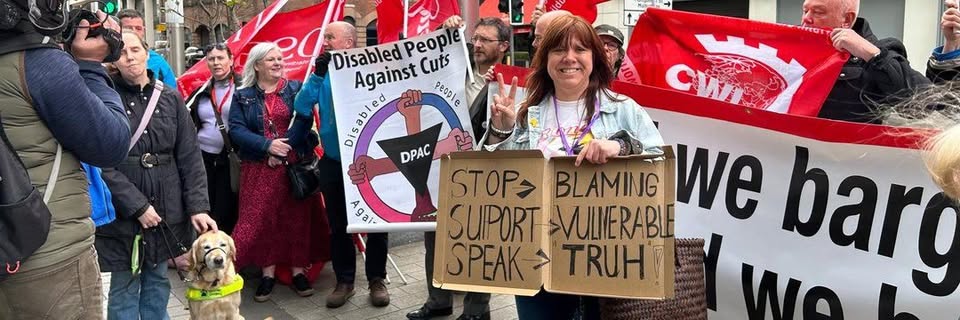
Some of the members of the Disability Strategy Expert Panel and co-design group have written an open letter critical of the Executive’s draft Disability Strategy.
The open letter, which can be supported and shared here, begins as follows:
“We, the undersigned, have signed this letter to make clear that that the Northern Ireland Executive’s draft Disability Strategy does nothing to improve the lives Deaf and Disabled people and will not progress our rights in any way. We are calling for an urgent rethink and significant revisions to the final Strategy.
The Strategy was an opportunity to work with Deaf and Disabled people to address the barriers we face daily in our lives. The draft Strategy is a massive disappointment. It has been developed without input from Deaf and Disabled people and it’s 58 commitments will fail to deliver any meaningful change to our lives or advance our rights as citizens. We feel devalued and disillusioned by the Executive and believe no strategy is better than this strategy.”
Furthermore, members of Disabled People Against Cuts have written a briefing paper to MLA’s which outlines their disappointment in the current draft strategy.
Disappointment with the Draft Disability Strategy – a briefing paper, January 2026, prepared by DPAC
Inadequate valuing of Deaf and Disabled people by the Northern Ireland Executive
Deaf and Disabled people have been without a disability strategy in Northern Ireland for over a decade. This current draft consultation strategy has been more than five years in the making. This has placed Deaf and Disabled people in Northern Ireland at a disadvantage compared to counterparts in other parts of the UK.
- Deaf and Disabled people in Northern Ireland do not enjoy parity with counterparts in the rest of the UK in key areas. For example: we do not have the same level of rights protections; access to Direct Payments lags behind the rest of the UK, denying Disabled people the same opportunity to live in the community with equal chances.
- Deaf and Disabled people have been experiencing regression as a result of measures implemented by the Westminster government. For example, as a result of the Universal Credit Act, an additional 50,000 Deaf and Disabled people will be pushed into poverty across the UK by 2029-2030.
We had hoped for a strategy with ambition, with better quality and substantial commitments aiming to progress the rights of Deaf and Disabled people in Northern Ireland given the delayed publication and the wider picture of regression. The draft strategy has left us feeling disillusioned and devalued.
We believe that more broadly Deaf and Disabled people will feel the same, having made clear to us in engagement around the Strategy that what they wanted most was a Strategy that changed things not another document that does nothing.
Inadequate co-production
Although the vision and outcomes of the draft strategy were co-produced with Deaf and Disabled people through the Co-Design Group, the commitments were not. This is not proper co-production and represents inadequate engagement in the development of the strategy. It contrasts with the approaches taken in other parts of the UK.
- The Welsh disability task force which informed its Disabled People’s Rights Plan operated on the principle of co-production. Over 350 external stakeholders and 200 Welsh Government policy officials worked together through ten working groups chaired by Disabled people and produced over 300 recommendations.
- The Scottish Disability Equality Plan was developed in co-production with three core funded Disabled People’s Organisations to ensure that the voices and experiences of disabled people meaningfully considered from the outset of policy making
- The draft UK wide national disability strategy was informed by a range of engagement methods including: a survey which was responded to by thousands of Disabled people, carers and family members; 42 Regional Stakeholder Network meetings; lived experience research; 10 meetings with the Disability Charities Consortium; 4 meetings of the Disabled People’s Organisation (DPO) Forum; 11 roundtable discussions with a total of 98 Disabled people about their experiences in daily life; 6 cross-cutting thematic groups with a total of 130 attendees including Disabled people and representatives from DPOs, charities, academia and think tanks
Poor quality and inadequate commitments
The draft Strategy has ambitious vision and outcomes but there is a large gap between these, and the 58 commitments designed to deliver them. The draft strategy lacks concrete commitments. The targets are not specific, measurable, achievable, relevant or time-bound (SMART) and this undermines the quality of the strategy.
The strategy makes frequent reference to the United Nations Convention on the Rights of Disabled People but fails to understand or to adhere to the Convention – which places an obligation on State parties to progress the rights of Deaf and Disabled people – by its omission of concrete commitments to drive forward improvements in our lives.
There is no new money or budget attached to the Strategy which is essential if we are to achieve much needed progress.
Many of the commitments in the strategy are nothing more than stating that the government will meet its existing legal requirements in specific areas or continue to offer existing, inadequate provisions.
The wording of the commitments in the Strategy fail to offer the ambition or scope required to improve our lives and progress our rights. Examples of this include, a commitment to continue to support the Blue Badge Scheme, a commitment to meet current Building Regulations in relation to Changing Places Toilets, a commitment to produce information in alternative formats (a legal requirement for over 2 decades) and a commitment to promote the participation of disabled people in public life (a legal duty on all public bodies since 2007).
A commitment to create a Regional Disability Forum of Deaf and Disabled people is positive. However, given the lack of engagement with Deaf and Disabled people to date, we believe there are questions about the commitment of the Executive to genuine coproduction going forward. We also question the value of such a forum if it’s role to help deliver the current draft Strategy.
There are a handful of other commitments with potential merit including a commitment on legislative reform and commitment to embed inclusive design standards in procurement. However, these commitments contain caveats in the wording that limit their impact.
The absence of an action plan makes a holistic assessment of the draft Strategy impossible. The fact that some strategic commitments read as actions reinforces our perception of a draft Strategy which is confused and lacking in ambition and clear direction.
Where do we go from here?
Other governments have listened and acted on criticisms to their draft plans:
- The Welsh government was heavily criticised for a lack of concrete targets and no new money for its draft Disabled People’s Rights Plan – not only by Disabled people and DDPOs in Wales but also by the Equality and Human Rights Commission who said it “risked failure”. Consultation on the plan – which did include an action plan of 48 short term targets – closed in August and the Welsh government is currently addressing the concerns before publishing the final plan.
- Scottish Disabled People’s Organisations withdrew support for the draft Disability Equality plan in October 2024, highlighting a profound disconnect between government promises and real action on disability rights. As a result, Scottish government revised the plan which was published in June 2025 with an increase in funding of £2 million for implementation.
We would urge our Executive to show the same commitment to listening to Deaf and Disabled people and our organisations.
Recommendations
As a matter of urgency the Minister for Communities and the wider Executive must engage with Deaf and Disabled people and begin a dialogue about the changes required to develop an effective Disability Strategy that changes lives and progresses our rights.
We are calling for immediate dialogue with Deaf and Disabled people to review the strategy commitments. We are calling on every Executive Minister to demonstrate genuine commitment and ambition, replacing the existing commitments with SMART targets.
No Strategy can be successful without resources. We are calling on the Executive to allocate a specific budget to deliver the positive vision and outcomes of the Disability Strategy.
Resourcing the Strategy was a key commitment asked from both the Disability Strategy Co-Design Group and the Expert Advisory Panel Report. There were other key commitments which need to be included the final Strategy including:
- A clear, unambiguous commitment to deliver legislative reform as a priority within the first few years of the Strategy
- A clear, unambiguous commitment to deliver improvements to data collection
- A clear commitment to introduce an ambitious and innovative programme across Government to address attitudinal change such as the commitment to embed the Social Model of Disability adopted by the Welsh Government
- Clear, ambitious commitments to improve our lives and progress our rights in key areas including independent living (including access to housing and social care), access to adequate standards of living, access to transport and the build environment, access to education at all levels, access to health services, and access to work and employment.
The involvement of Deaf and Disabled people is key to developing and delivering an effective Disability Strategy. To date engagement has been disappointing, leading to us feeling disillusioned and devalued. We are calling for an ambitious approach to engagement which embeds General Comment 7 of UNCRDP into future coproduction. This must include the involvement of Deaf and Disabled people in deciding the role, remit and membership of the proposed Regional Disability Forum as well as identifying other mechanisms to promote and embed our participation in the work of the Executive.
Publishing a draft Strategy without an Action Plan means it is incomplete, making a proper assessment impossible. It is of concern that the Department has not specified when and how the Action Plan will be developed. We are calling on the Executive to develop a draft Strategy including an Action Plan, designed with Deaf and Disabled people, to support the delivery of its vision, outcomes and revised strategic commitments. Examples of what should be included in an Action Plan are:
- Reform social care in partnership with Deaf and disabled people which rules out social care charging
- The expansion of Independent Living Fund to new applicants in Northern Ireland as they have done in Scotland
- Introducing free travel for Deaf and Disabled people in parity with the rest of the UK and Ireland
- Further changes to Building Regulations increasing requirements around providing Changing Places Toilets and a dedicated fund to increase provision
- A funding programme to encourage the development of Deaf and Disabled People’s Organisations (lead by Deaf and Disabled people) in Northern Ireland
The draft Strategy covers the period 2025-2035. 2025 has already gone and there no clear picture on timelines for a final Strategy and its delivery. Clarification is urgently needed on timelines as well as revision and strengthening of how progress will be measured once published.
The consultation for the Executive’s draft Disability Strategy is open until 20 March 2026. NIAPN encourages groups and individuals to engage in the consultation and respond.