
“This Strategy will not work. It is just listing things are already in place.”
19 September 2025
By Becca Bor
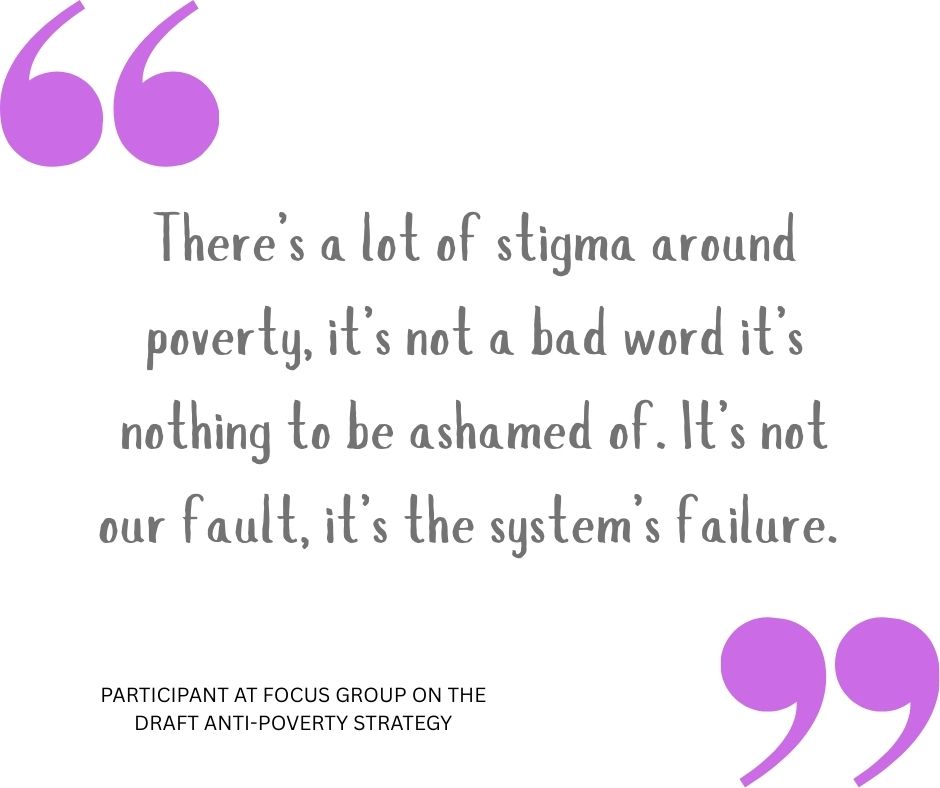
NIAPN, in partnership with Women’s Support Network and Save the Children Northern Ireland, created a toolkit for engaging with people with lived experience of poverty in conversations about the draft Anti-Poverty Strategy. 145 people with lived experience of poverty responded to our feedback form. Below are their views on the draft Anti Poverty Strategy and what they believe should be included within it.
***A special acknowledgement to Siobhán Harding, Women’s Support Network, who collated all of the responses and pulled out the clear recommendations***
Summary of Anti-Poverty Strategy Feedback forms
145 responses completed
- Do you think that what is in the draft Anti-Poverty Strategy will make a difference to the financial hardship/poverty that you or the people and families you work with experience?
The majority of respondents (78%) felt that the draft Anti-Poverty Strategy would make no difference to the financial hardship and poverty that people experience. A further 15% reported they were unsure if the draft Anti-Poverty Strategy would make a difference and only 7% felt that it would make a difference.
Additional Comments made by respondents:
“A lot of the suggested interventions in the Strategy are not new. Research has already been done and there is a stronger set of proposed actions that you could implement.”
“Personally, I don’t see it as fit for purpose because it fails to set out the concrete steps needed to tackle poverty meaningfully. Despite legal and political obligations, the draft strategy does not properly reflect expert recommendations, lived experiences of those in poverty, or the wider social and economic challenges – such as the Cost-of-Living Crisis, austerity and an inadequate welfare system. It lacks a robust, evidence-based and cross-departmental approach. A genuine Strategy must be comprehensive, adaptable and driven by clear commitments and actions across all government departments to have any real impact.”
“Many of the actions already exist and so will do little to lower the rates of poverty. Moreover, a lack of actionable targets/time frames leaves little space for accountability.”
“This Strategy will not work. It is just listing things are already in place.”
“These people are throwing poor people’s issues into a pot and sitting them on a dark shelf. People are crying out for help and no one is listening. People in poverty are unseen.”
“It’s just a continuation of what is already in place and the numbers for poverty are still rising. It is not going to work.”
“The draft Anti-Poverty Strategy will make very little or no difference for those of us in financial hardship! The draft that has been released is quite frankly a slap in the face. I myself see hardship every day! I work with it, I see it and I lived it. What I can see in this draft is a continuation of what already exists no big changes no big plans … no money! How any government could listen to the lived experience, nod along with it and then publish a document as cold, heartless and meaningless as this, is a real shame for Northern Ireland. I am disgusted and I know I’m not alone.”
“All children entitled to free school meals and help with school uniforms.”
“How does this Strategy compare to other countries and to Europe? The Strategy seems to be gender blind. Intersectionality is not just about disabilities. While the Strategy does mention migrant families it doesn’t look at the full picture of social inclusion and poverty.”
“Nothing has changed, prices keep rising so there is more poverty. No incentive to get into work, basic needs are not being met.”
“It needs thrown out and they need to start again. No real change in it. Need to hold open talks to hear exactly what people need not what they think will help.”
“They haven’t put anything new in it. They don’t help working people. People are staying in poverty and Universal Credit is making people worse off than they were.”
“They didn’t mention single mums in the draft. There is no scheme for single mums to get into training or employability and education.”
“The Cost of Living has gone up so much, some families are really struggling even people who work are sometimes worse off.”
“Universal Credit is causing hardship and should be scrapped.”
“The Cost of Living is rising and wages aren’t going up. Rents need to be capped.”
“There’s nothing concrete, it needs to be more specific with targets and actions that will make a real impact.”
“It is not fit for purpose. It doesn’t commit to changes so can’t be challenged. It’s not fit to wipe my backside with.”
“Vicious cycle that won’t really bring people out of poverty.”
“A lot of things are already in place like free school meals so there will be no positive change. May have an impact on individuals but not suitable for all. Need more awareness of what poverty is for people to recognise what it is.”
“How can Scotland provide a child payment to take children out of poverty when we are keeping people in poverty? Navigating the system is really, really difficult, it’s all online. How can people pay for Wi-Fi and a smart phone when they are on a state pension with no access to pension credit because a partner is still working?”
“Many of the points made seem to be pre-existing and because it’s so vague it’s hard to tell what will be done.”
“Not much change, seems more ‘continuing’ and ‘research’ less new actions.”
“It comes across like it’s written by people who have no experience of poverty or how people end up in poverty. It’s just going through the motions.”
“Definitely needs improvement. Help is needed to transition to Universal Credit as the stress has not helped my mental health.”
“People need things explained in a way they can understand.”
“It is astonishing in this day and age that there is so much need for charitable organisations. The government should meet its obligations to support all members of our society.”
“There are groups I don’t see in the Strategy like younger people with disabilities.”
“The women we work with are already unsure of the practical resources and services available. How will these changes affect them further?”
“Women do not know what they are entitled to, not enough information available. Strategy is all about “continuing” already existing methods which clearly are not good enough.”
“A Strategy with no real change is not going to get us out of what we are already in.”
“I can see no change, no help, no care for those of us in poverty. This is a disgrace.”
“We need to see change implemented to reduce financial hardship like lifting the two-child limit.”
“It’s ridiculous that it’s taken 19 years to continue what’s already in place!”
“I don’t think anything will change for me from this.”
“They are keeping people below the baseline and not increasing the things that are working.”
“Government must listen, understand and bring in measures to change poverty in our community.”
“Everything is “continue” so no change. If they’re not listening then they don’t know what needs changed.”
“Costs need to be capped such as childcare and rent and the cost of school uniforms.”
“The draft doesn’t change things like uniform grants that should not just be for people on benefits. They have not put things into it that weren’t already there.”
“NO real confirmation of changes with actual measurable budgets or targets and planned impact.”
“Talk to people, use their experiences as examples, change the stigma and get conversations going on poverty.”
“There are no concrete actions more than is already in place.”
“No specific changes, still delivering stuff that has already been in the system. No concrete changes.”
” It took time to get this draft Strategy so the figures they were using would have possibly doubled or even tripled by now.”
“It doesn’t really say what will be done or what is being done.”
“I don’t think anyone listens to working class people that are living through all of this.”
“I don’t think they fully understand how their decisions effect both working and unemployed people. Poverty is at an all-time high.”
“They need to understand how their decisions affect both unemployed and working people.”
“Give help to people and support them when they get out from prison and don’t make a difference between people who get out from prison and others.”
“I think more needs to be done with housing. Support is needed to get people jobs and a safety net for those that work hard but still can’t make enough to survive.”
“Wages from work can be poor and salaries sometimes do not cover everything.”
“It is not a serious strategy it lacks targets, and clear resources to for the actions needed.”
“The blatant ignoring of tangible anti-poverty research is an affront to those living with daily hardship. Surely a commitment to change needs more than what is already in existence?”
“There are suggestions within the draft which have no details added, e.g. support for people with disabilities. How will this happen? No further research is needed into the impact of the two-child limit on poverty.”
“This is not a strategy just a list of things the government is already doing.”
“Targets need to be set and met or it will not work. There needs to be accountability.”
“It needs clear objectives and targets, goals and accountability if these goals are not met.”
“I don’t feel it will work as there are no measurables, goals or accountability. Need proof that the strategies in place are helping now never mind in the future. There is also no mention of increasing grants in general.”
“This Strategy is absolute nonsense. There are no targets, no accountability and it seems no actual interest in sorting out poverty in NI. They have to listen to the professional recommendations that they were given.”
“I don’t think there are any set in stone or reasonable targets mentioned. There needs to be actual goals/targets in order to make change and someone needs to be accountable.”
“Feel that it doesn’t do enough to improve things or reduce hardship.”
“It is not realistic and does not go into detail how it will support service users.”
“The current draft will do nothing for the people in our society. It will be a paper exercise for Ministers to hide behind.”
“It doesn’t offer any really new or different information. It does not actually provide practical changes that will support people or make real day to day differences for people.”
“There are no actions being highlighted in this Strategy for actual change.”
“I think its just lip service, the initial mission statement seems so unrealistic and it’s just empty words to address the discourse but won’t go anywhere as they’d rather argue about an Irish language sign in Grand Central station or who wore a Rangers top to a meeting.”
“Funding for this – is it ring-fenced or will budgets be cut in other areas?”
“The Anti-Poverty Strategy in the past has done nothing for families or to address poverty and there is nothing within this draft Strategy that has addressed these issues meaningfully again. Until the core issues of funding of services and cuts are addressed it is just a waste of time and paper.”
“They need to be giving people more money, free school meals for all children, they should have a hot meal each day.”
“To include support including for heating and electricity grants to support households facing financial hardship – especially for families in need. I work in a family and child care team and this is a massive issue/area for need.”
“The draft Anti-Poverty Strategy will negatively impact our service users (children, older people). It looks more like a “(how to keep) Poverty Strategy” maintaining people in poverty long term.”
“It’s going to make things harder for service users who are already facing poverty with the increase of life costs – I have had to support people with food banks and give them numbers for food banks to support them.”
“There is no information regarding threshold of support – the working poor need more support to enable them to stay in work.”
“This draft Anti-Poverty Strategy is not bringing anything new in. With the ongoing Cost-of-Living Crisis working-class people are living in poverty with no support in place. Childcare costs are a rising concern and as a professional, I still had to take a career break for 2 years as my wage was not covering my childcare bill.”
“It is a poor response to families, service user groups and ‘the working poor’ who are managing day to day with the cost of living. There needs to be set quantitative and qualitative goals to eradicate poverty and give all people in society a better opportunity to succeed in life. Meals for children, all school uniform and childcare costs are the minimum expenditures that need to be covered by the government to support children to succeed and encourage people to work and contribute to our society as a whole.”
“It feels as though it is based on pre-existing programmes that are already in place and whilst they help they are not making a massive impact on child poverty.”
“I don’t believe that it will make a bit of difference because any many of the ideas put in place are already there. The ideas that have been added do not give enough detail, with no figures on how this will work to help families.”
“Cutting help for those in most need, knowing rightly that they have the weakest voice and least exposure is just inhuman and those responsible should be totally ashamed.”
“It does not do enough there needs to be a clearer layout of goals and how these goals will be achieved. We need to have a clear achievable timeline of when these goals will be implemented and achieved.”
“It is still so unclear – no budgets/targets to reach.”
“While outcomes are stated, eg, “everyone supported to improve mental and physical health”, the Strategy often lacks concrete, measurable targets beyond existing programme continuation. In terms of funding the document acknowledges significant budget limitations, especially in early years, which may restrict delivery. Service pressures are unaddressed. The Strategy notes that health inequalities drive demand on services but offers limited new measures to reduce waiting times or expand access to primary/mental health care. Lifestyle determinants are underdeveloped. There is limited focus on preventative health (eg, exercise, diet beyond food poverty) and broader wellbeing initiatives. While indicators (eg, healthy life expectancy gap, drug/alcohol admissions) are included, the approach relies heavily on monitoring rather than clear commitments to reduce the gaps within the 10-year span. Although lived experience is acknowledged, more detail on how communities will directly shape health-related interventions would strengthen impact.”
“The draft Strategy is a step in the right direction, but at present it is too broad and lacks clear, measurable commitments, funding and accountability. Families experiencing poverty, particularly lone parents, often face immediate challenges such as childcare costs, housing insecurity and barriers to employment. Without specific actions and resources directed at these areas, it is difficult to see how the draft will make a real difference to day-to-day financial hardship. The Strategy needs to set out practical supports, timelines, and clear targets if it is to genuinely change outcomes for families.”
“It is not going to help. There needs to be clear firm goals set in place of what is planned and how/when it will be delivered. I am a single mum of three due to an abusive relationship. I have a severe long term medical illness, as does my daughter, due to it being hereditary. It is a struggle each week to get the help that is needed, especially financially to support our family and this Strategy only makes the anxiety over fears of being able to afford to live worse. If I could work, I would but I am unable to. If my daughter and I could be free from illness we would but we are not. Due to this, our family has to rely on benefits and it is a constant fear of whether we are eating, getting clothed, having electric, etc. As the cost of living rises this fear, stress and worry only gets worse, which then in return, causes more health issues.”
“I don’t have much faith in our politicians to make the decisions, but they really need to help children in poverty which can be hidden in shame and causes lifelong issues with health and education.”
“People need social security – that means payments that will fund a basic lifestyle but this Strategy has no targets and won’t change poverty.”
“It is not fit for purpose.”
“The Strategy doesn’t outline what action is going to be taken to make a difference to the hardships people are facing. Without a clear framework or timescale it has been produced with a great deal of disconnection from what is actually needed to benefit those who are most at risk.”
“The current Strategy is totally inadequate and I urge the Department for Communities to complete a re-write using the evidence-based recommendations from the Expert Panel and Anti-Poverty Strategy Group.”
“There is no budget and timescales.”
- How do you rate the draft Strategy overall?
The majority of respondents (82%) rated the draft Anti-Poverty Strategy as ‘Poor’ with a further 15% rating it as ‘Average’. Only 3% rated the draft Strategy as ‘Good’.
Additional Comments made by respondents:
“At the moment, I don’t really rate it at all.”
“Very poor. I agree that it is worse to have a bad strategy than no strategy.”
“The Strategy does not consider older women who are living in poverty, who worked part time jobs their whole lives to accommodate care needs of their children and their parents, and who are now trapped in poverty.”
“It should be people in poverty dealing with this – not people on big wages.”
“The people making the decisions have to come out and see how desperate people are.”
“It’s a start, they have identified the causes but where are the actions to change things?”
“This is a reprinted sheet of continuation. WE DON’T WANT CONTINUES WE WANT CHANGE! They know the factors causing poverty, they know the solutions and the Strategy we need to take. However, they don’t want to fund it, they don’t want to be bothered with it and to be honest it’s because they don’t feel the money deserves to be spent on the poor.”
“Need to put Strategies actually in place and not just a list of suggested actions. Listen to what people actually need and act on it.”
“Free school meals for all school children and increase school uniform grants.”
“Strategies that are gender blind will fail.”
“Does not include the basics. People will still struggle there is no change. Needs new stuff in the Strategy and take on board the views of the real people. Over 60s are discriminated against.”
“No real new steps only continue to do things – that’s not going to change anything. PIP cuts are really worrying to people who this will effect.”
“The price of living is going up and people are unable to feed their kids and heat their homes. People who work on zero hour contracts it is not good as people don’t know from one week to the next.”
“The cost of living is going up and things are getting worse and families are struggling.”
“It didn’t cover homeless leavers from school and drug problems from an early age for kids.”
“Universal Credit should be done away with as people are worse off.”
“The Cost of Living is so high and there is no encouragement to go out to work.”
“Do away with Universal Credit and remove the two-child limit.”
“Just ‘continuing’ with things – nothing new. No increased resources. Where will the money come from for the new plans?”
“No actions just words.”
“Really poor – this Strategy is not going to support people – we need to get rid of the two child limit in Universal Credit. Free school meals should not discriminate we need to look at other countries. Families are so afraid of the judgement/stigma with poverty so they are not reaching out for help.”
“Although there’s an awareness of the issues, budget, timeline and actions are unclear. Not enough is being done.”
“Unclear what RAISE aim is? £20m investment is a lot of money – would this money be better spent improving existing schemes?”
“One of the most important things that is needed is ensuring people who need money get it. We need to have an understanding of stigma, inflation and what people need to have a basic standard of living that includes mental wellbeing and happiness.”
“Food shopping has gone through the roof – need extra help to reflect this.”
“Pensioners seem to be forgotten.”
“Access to all benefits a person qualifies for. Transparent and helpful advice should be readily available. Expectation that everyone can access online information.”
“Costs are extortionate these days and the future needs to be safeguarded.”
“It’s not reflecting any concrete changes to a failing system. Giving us more of what we haven’t got.”
“Not good enough, women will continue to be let down. Need more information and concrete action plan of how they are actually going to make it better.”
“We need more stepping stones to be able to help ourselves out of poverty.”
“It’s dire!! Complete joke! Politicians out for themselves!”
“Not good enough.”
“They’re not actually saying what will change. Very vague “continued support”.”
“There’s no identified actions for people to understand clearly.”
“In our society there should not be a need for people to rely on charity. Politicians should be ashamed of the conditions that people are forced to accept.”
“They aren’t listening to the people living in poverty. They don’t live in poverty so they don’t have a clue.”
“I don’t see a clear path out of poverty. There seems to be intentional strategies to keep people in poverty.”
“There are no new changes in the draft. Most things that are in it are already being implemented and there is nothing that can be talked about.”
“Hard to understand, lots of words and no real actions.”
“After 19 years I expected much more. Feels like no real concept of living in and around poverty and the impacts on families and communities.”
“I believe that this Strategy is poor, there are so many children in the area I work with struggling with poverty. They have limited opportunities which will have an impact on their lives.”
“More constructive actions are needed to address the real issues on the ground.”
“They are paying lip service to problems that are not being addressed and they need to put specific improvements in place.”
“I think the people implementing this so-called Strategy and those researching it need to actually see just how bad things are for those affected by poverty. Working or on benefits.”
“It’s mainly things that are already in place – there’s not much new and they’re not saying how they’re going to fix it.”
“It’s a disgrace, making the rich richer and the poor poorer.”
“The draft Strategy is very slow in happening and does not meet all the requirements that are needed.”
“Working people are also struggling after childcare and expenses. They need to consult with shops as the prices are too high. They said it was because of Covid but that’s well over now.”
“Working people are really struggling to survive. Every week you go to get groceries and the prices have gone up so something needs to be done about that.”
“Some areas are missing like if a person has children with special needs what’s in the Strategy for them? What about ethnic minorities?”
“It’s very vague.”
“Government need to help people, everything changed after Brexit.”
“It’s very poor.”
“Housing is very poor, benefits are not enough to cover food and heating costs.”
“It’s not a complete draft when the proposed parameters for measuring outcomes will be after the initial draft and without consultation with those with lived experience!”
“No targets and goals in place so there is no accountability and nothing to reach towards to show work is being done and in a timely manner that will be beneficial.”
“They need to be consulting with real people before the draft is finalised. They should be included in every stage.”
“It’s a disgrace, we need targets and actions being taken.”
“RAISE seems to be the only new things they added, and it is still under investigation. This is simply not good enough.”
“We do not need more research for the two-child policy – we have all the research and evidence.”
“It’s watered down and a cop out. The two-child limit does not need more research, it’s a waste of money to do research that has already been done. Too much of continuing what is already in place – no expansion.”
“I feel there is no structure or fairness in this Strategy the aim seems to be to focus on the old plan rather than trying new things.”
“It will make no difference to people in poverty. They need to listen to the people that know how to fix this.”
“Again there are no actual goals or targets. So nothing can change or improve until this is done.”
“Needs to be more in depth.”
“It is not a realistic document and seems very out of touch with the reality of the day to day cost of living.”
“Lacks detail on the practicalities of the plans.”
“It is disgusting that there is basically nothing new in this draft to be introduced.”
“Very little empathy or recognition of how significantly poverty impacts people and communities. For these groups of people it feels that the government has no real interest in making any real and tangible changes. Our politicians need to sit down and listen to the real life experiences about how poverty impacts every part of someone’s life, long-term.”
“NI is always on the back foot compared to the rest of the UK, disgrace!”
“Tokenistic measures and lip service will not feed our families, keep them warm and give them any quality of life. Redirect our tax money away from the pockets of the rich and use it to assist the public as it should be.”
“Lack of immediate relief – families in crisis need urgent support with food, heating, housing – a Strategy that feels too long-term might not meet urgent needs.”
“It’s a waste of time without addressing the core issues.”
“They have not put any amounts on what they are going to give out. How can people go back to education when they will struggle with their mental health, if they try to better themselves they will be penalised with benefits taken off them.”
“The draft Anti-Poverty Strategy is very late, unclear and a smoke screen for the future of Northern Ireland 2025-2030 and beyond.”
“I do not think it is going to be able to help people who are working and have extra childcare costs, who are not going to be able to make their bills – electricity, gas etc.”
“The working poor need support – even when an individual is in receipt of Universal Credit – they do not automatically meet financial support for free school meals, uniform grants, discretionary support – also some people do not realise they can avail of additional financial support.”
“It is just a tick-box exercise which our government has not put much thought into. These people are not living in poverty and they need to do more consultations with groups of people who work with individual’s living in poverty. They also need to speak with the individuals themselves and learn what is needed to help them come out of poverty.”
“We need set goals and clear targets to eradicate poverty within our society. I would give it a 2 out of 10.”
“Closer links to the people/children which it will impact/benefit. We need to address issues that are mostly impacting children and families. Free school meals, greater supports for school uniforms, better support for childcare provision. Helping children in key foundation years, ensuring they have the best support in their lives as their peers.”
“Politicians are out of touch and need to ground themselves to the level of most of the people with real lived experience.”
“The draft simply does not look at what policies work in the rest of the UK and implement here in NI. Typical political fallouts stop progression in this country.”
“It appears poor – it appears like a tick box exercise, with no clarity on how these goals will be implemented or achieved.”
“I rated the draft Strategy as poor because it lacks clear, measurable actions, funding commitments and accountability. While the vision is positive, the Strategy feels too general and doesn’t give confidence that it will result in real change for families who are already struggling. It does not go far enough in addressing urgent needs such as childcare costs, affordable housing and adequate income support.”
“I think the people that write this up should try living on the terms that they are suggesting for us and see just how poorly it has been thought out. There is no clear understanding of what reality is like, on a daily basis for those of us that fall under the bracket of needing help from these organisations and government.”
“More help for families with children, school meals should be free and uniform help for all those people on low income.”
“People aren’t poor because of character defects or an inability to budget – it’s usually bad luck or illness, disability and broken relationships that mean people end up in need. It could happen to most people.”
“I feel the Strategy is a good starting point, but without any clear action plan it falls short of being an Anti-Poverty Strategy, it’s very out of touch of what’s really needed and feels like it was written without acknowledging the lived experience of what poverty really is in 2025.”
“The current draft fails to include measurable targets, time-bound outcomes and dedicated resources, as highlighted by oversight bodies like the NI Audit Office and Public Accounts Committee. Public scrutiny of the Programme of Delivery and action plans has also been absent. The Strategy’s three-pillar approach ignores the systemic causes of poverty, instead placing responsibility on individuals and reinforcing stigma, such as attributing poverty to family breakdown without addressing underlying financial stresses. Nowhere is the voice, experience, expertise, and insights of people experiencing poverty seen in either the descriptions of the barriers or the solutions to them. Additionally, there is no mechanism illustrated within the draft Anti-Poverty Strategy to engage meaningfully with people with lived experience of poverty throughout the development, implementation, and duration of the strategy. The Department cannot just amend this draft ‘Strategy’, it needs to be completely rewritten using the evidence-based recommendations from the Expert Panel and Anti-Poverty Strategy Group.”
“Very poor.”
- Can you list some things that you think would make a difference to the financial hardship/poverty that you, your family and community experience that you think should be included in the Strategy?
“Free school meal payments over holidays to stop holiday hunger. Introduce a Child Payment like in Scotland. Put a price cap on school uniforms. Increase the School Uniform grant and include costs for shoes.”
“We need a real Living Wage, because low pay leaves young people struggling to take part in normal social life, pushing many towards addictions. Families need benefits that match the true cost of living, affordable housing, and support with essentials like food, energy, and childcare. Poverty won’t be solved by one department alone — the whole government must act together to give people dignity and stability.”
“A Universal Basic Income so everyone’s basic needs are met. Free childcare or a community focused childcare model that does not rely on subsidies which many families don’t feel the benefit of. Providing free school meals over the holiday period to stop holiday hunger among children and young people.”
“Affordable childcare to allow women to go back to work.”
“Stop pressuring people to get into employment as if it is the only thing in society that gives a person value and makes them visible. Put well being at the heart of an anti poverty strategy.
“Stop pressuring people to get into employment as if it is the only thing in society that gives a person value and makes them visible. Put wellbeing at the heart of an Anti-Poverty Strategy.”
“Employment strategies to ‘help’ people into the labour market do not differentiate between a young person starting out a life and an older person, especially women, who has almost reached the end of working life and do not have the energy or capacity to look for work of 35 hours a week.”
“We need fair and equal pay for everyone. People on disability and carers are not getting enough to help them face every day struggles.”
“Help with uniform costs. free school meals for all. Stop pushing people into poverty and actually help them.”
“We are entitled to our human rights. They should not be violated by the government not providing housing, health care and school meals. Change has to come now.”
“More help with school uniforms £42.50 hardly covers a thing. Also some more stepping stones to help get mothers back to work. Affordable childcare, payments open to everyone to help with costs of childcare or even the 30 hours free childcare that’s already in place in England. We also need more available grants than loans in Discretionary Support. Help us out of debt not to get into it.”
“Raise Universal Credit to meet the cost of living. That’s a no brainer. Enforce 30hr free child care across the island like in the UK. Scrap the two-child limit and provide support to families like Scotland are doing. Extended free school meals and actually think about what a school uniform costs and raise the school uniform grant.”
“We want more job security in Northern Ireland and flexible roles. Better paid work!”
“All children should have free school meals. Increase the threshold for entitlement to uniform grants. More help and support with disabilities. When moving across to Universal Credit – no five-week wait without any money.”
“Primary and secondary school children should all get free school meals.”
“Identify all the areas of intersection – unpaid carers, lone parents, carers, disabilities, pensioners, homeless/insecure housing, rural, crisis due to illness, workers, communities, self-employed. Tenancies vs private landlords vs homelessness.”
“Reduce fuel costs, paid into meters and to fuel companies. Information should not be just online and on social media not everyone accesses this.”
“Help for single parents and disabled people. Help with housing and social houses and regulate private rents.”
“Reduce the meter rate for electricity/gas rather than a one-off payment for fuel costs – this would cover the Winter months. Self-employed people get no help – there’s nothing for them and small business – the working poor.”
“They should put a cap on private rents as people have to pay out of their benefits and it’s leaving them without money for food and heating. I think that people are getting poorer. Working people have to pay for school uniform and dinners and this takes a big chunk of money from their wages and leaves them struggling. I think the rich are getting richer and the poor are getting poorer.”
“Cost of heating your house and electric is too high especially in Winter.”
“Universal Credit is the worst thing that the Government has done, it has made more poverty than anything. Rents need to be capped.”
“Food prices, electricity and gas prices are getting worse. The price of children’s clothes and uniform and shoes and all essential items are ridiculous.”
“Help with school uniforms and increase in the level of benefits as the Cost of Living keeps rising. Free school meals for all children.”
“Increase in wages and rents need to be capped.”
“Help with school uniforms and school dinners and help to feed families on low incomes.”
“School uniforms capped. Help with the cost of living, the cost of food, electric, clothes, baby food, fuel.”
“Free school meals for all children in primary and secondary schools.
Help for the working poor. Make working more attractive – remove the barriers to leaving the benefits system as for some it’s not worth working as benefits are safe, consistent, so why bother working?”
“More support for people with addictions. More support for people up or downsizing according to their housing needs. Healthy Start vouchers – they should pay for a tub of baby milk without having to put money to it. Stop the big wigs high wages and expenses and give them back to the people who need it.”
“Current caps reviewed to support working families. Increase the thresholds for being able to get help. Warm meals for all school children not just the ones whose families are on benefits. Remove the two-child limit.”
“The Strategies that are being continued need to be reviewed and involve the service users in any new Strategies. Improved and additional support is needed for new services and continuing services. More resources for factors such as education.”
“We need support with childcare for working families, we need a price cap on uniforms and we need to stop wasting more on reactive issues and look at investing the tax payers money into early intervention and prevention. Do the people who hold power in these decisions want to see what real poverty is – look at our food banks, our local family support hubs, our full time working families struggling to pay bills with the cost of living. NI is in a state of crisis.”
“Remove the two child limit. More heavily subsidised/free childcare. Greater awareness of programmes and help. Better access to benefits and awareness. The Strategy needs to meet the same level as the rest of UK and ROI – make more of an effort. It shouldn’t make more financial sense to stay on benefits than to work – changes are needed.”
“End the two-child limit. Introduce the child payment here. Help with fuel and food costs needed. Help with childcare payments for working families so that they can benefit from their earnings and not be working to pay for childcare.”
“I have a child who was a detained patient for more than 18 months. While she was in hospital our outgoings increased dramatically. We had to switch to Universal Credit at a time while I was on half pay from work, the five-week wait was really hard and I couldn’t budget because I didn’t know what my income was. I had to use a social supermarket to eat and ran out of money regularly. Universal Credit should remain in place for children in hospital, as should PIP if the child is over 16 and in hospital. We lost over £700 a month at a very stressful time. Also, Carer’s Allowance is lower than unemployment benefit and it should be higher with a taper for earnings rather than a cap.”
“There’s not enough information on the Universal Credit changeover for people who are disabled.”
“Easier access to Universal Credit and easier to apply – feel they are making barriers to access. Get rid of the two-child limit. Cap on school uniform costs.
Raise threshold for free school meals to reflect minimum wage now. Having to go back to work when child is 3. It used to be 11. Getting calls from when the child is one year old. Getting childcare is harder. There is no help for working people struggling in poverty. A Christmas bonus in benefits would be helpful to people. More support for carers – they are lacking in support and the money they do get doesn’t take into account the electricity to run hospital equipment, etc. Get rid of zero hours contracts. Provide free school meals for all children.”
“Take away Universal Credit.”
“Move to generic school uniforms. Subsidise energy costs. Reduce public transport costs.”
“Tailored services directed to marginalised groups without a lengthy wait on referral lists.”
“More understanding of women’s hardships – domestic abuse, etc. Women experience poverty differently to men, there is no one size fits all approach. Improved support for women trying to access education and employment, fair pay for both men and women.”
“Increase the school uniform grant. Provide affordable childcare. More funding to schools for snacks/classroom equipment. Help with gas and electric. Schemes to help with the Cost of Living. More grants to help with daily living needs – furniture, house appliances, etc.”
“Free school meals extended. 30 hours free childcare. Rise in Universal Credit/Healthy Start payments. Cheaper uniforms or higher payments to help with them – they are not enough.”
“Lifting the two-child limit. School uniform grant increased. Help with childcare costs.”
“Increase Child Benefit and Universal Credit. Remove the two-child limit. Include nursery age in school uniform grant and increase the grant. Solar panels to help cut the costs of electricity. Help with childcare. Lower afterschool costs – put a cap on them. 100% Christmas bonus in benefits. Increase in the Healthy Start amount. Hot meals for ALL school children.”
“If they would actually fund schools then they wouldn’t have to ask parents to provide additional costly items. Cost of school uniforms is extortionate.”
“Those in power should be challenged to live on the money families in poverty have to survive on. Power lies with the people. We need to encourage people to become aware of the government plans. Join together and demand the changes we need.”
“Better examination of what poverty is and how it affects the average person.
Implement some of what the Republic of Ireland, England and Scotland are doing.”
“More help for self-employed people. People working in education not being paid over summer break and unable to apply for benefits.”
“Benefits need to increase along with help for the cost of living at the same time some things should be capped such as childcare, uniforms and rent.”
“Making sure that the working wage will help people stay out of poverty. School uniforms should be set at the same price for all schools. The two-child limit should be lifted as it has a detrimental effect on families.”
“Remove the two-child limit. More help with childcare costs. Have a look at what’s happening in other countries.”
“Real tangible changes needed. Investment in people and communities to foster real growth in NI. When money can be squandered on photo opportunities, consultants, advisors and expenses it’s time for the NI Executive to spend more wisely. We deserve better!”
“People’s experiences, the voices of people experiencing these hardships need to be heard. They need to look at different ethnicities and bring people together from all over NI.”
“Cap on rents. Cap on school uniform costs. Schools implementing a uniform exchange. Re-instate the Holiday Hunger Scheme. Ask the people living in poverty.”
“Bureaucracy – need to reduce it and make life simpler. Need more information. Make it easier for families to be better off when they do go to work.”
“Listen to grassroots people like those who live and work in the communities that suffer from poverty and not researchers that know nothing about the communities.”
“Make it easier to get educated to go out to work.”
“Free hot meals for all children at school. Better help with childcare costs.
Reduce the price of food, etc. Families are not eating properly so their health and mental health are badly affected.”
“It took 19 years to get this far to get a draft Strategy yet they are not taking immediate action to resolve these problems. Parents are on their knees trying to cope with their bills. It’s no use doing a survey unless you’re going to act on it.”
“Free meals for all children at school would be a start. Parents are stressed out trying to make their money last and of course the bills get higher and higher. Doing surveys doesn’t work unless you act on them.”
“Have a gateway benefit for those just above the threshold and are not eligible for any benefits/support for example with rates, school meals and uniforms.”
“As a family support officer day in day out families are coming in upset, angry because they can’t afford to eat or heat their house.”
“More help needed for childcare costs and support from employers with childcare.”
“Help with housing when getting out of prison. More benefits for children.
More help for people with a disability.”
“Need help with housing when you get out of prison. Need help to get benefits sorted when out get out of prison. It’s really hard to get a job when you get out of prison. When you get out of prison you need photographic ID and it’s really hard to get it. Need more put in place to help people before they leave prison so they don’t get out and end up reoffending because they have no home or not enough money to live on.”
“Lot of people are in and out of prison – they get out with no home and end up homeless then end up on drugs and drink – they need to address that so that people don’t end up coming back in. If people are on license they have some accommodation provided for them – temporary accommodation but if you get out at the end of your sentence you need to find housing yourself. If you’re in prison and you don’t have family support when you get out its hard and people need support. A lot of people don’t have the skills to cope in the real world – they need basic life skills – they don’t know how to live in the real world.”
“Moving on from being homeless and try to house people with affordable housing. More help with childcare for families in crisis – if they end up taking on another child as someone has gone into prison they struggle to get any financial help.”
“Better laws to stop landlords overcharging for rents. More support and information for people who want to work but find it hard to live or even eat because the pay is too low.”
“More help for childcare costs. More help for households on a very low income. More help with school meals. Increase in low wages/low incomes.”
“Better wages. Better housing. Better support through the benefits system.
There should be more support for heating, food, electric bills.”
“Reform of the benefits system, to provide help not penalise those in need.”
“Clear distinction around protections for disabled persons getting back into work – “right to try” scheme in particular. Protections for women and children leaving domestic violence and experiencing post-separation abuse, including vulnerabilities around financial abuse within the current benefit system.”
“After the sudden loss of a full time job and being forced onto Universal Credit because of a disability the five-week wait is too long and Discretionary Support only offers a small amount for the whole time. There is not enough support going from full time work to nothing and that forces people into poverty. If people on Universal Credit are getting the maximum loans they can, when it comes to repaying it, they do not have enough money for food and household supplies.”
“Free school meals for all, introduce a school uniform cap and more help for people with disabilities.”
“I don’t want to just be heard, I want to be listened to. We should know how the newer things like RAISE are run and how decisions are made.”
“We need better decisions made for change. We need people with life experience to be heard. We need free school meals for all children. Get rid of the five-week wait for Universal Credit.”
“Universal extended school programmes – more funding for the cost free school day. Lived experiences should be listened to. There should be a cap on school uniform costs and they should be unbranded. Prevention is possible, we don’t have to wait until people are in crisis. Preventing poverty will increase quality of life, invest in our children’s education and mental health will progress in our job opportunity and money into NI.”
“There should be fairness and inclusion. We should look into more funding and better strategies.”
“Free school meals and an increase in the school uniform grant. A better understanding of each disabled person’s needs. Stop pigeon holing disabled people. Do away with the five-week Universal Credit wait because it pushes people into debt. More sensible rules around Carers Allowance.”
“Put more money into school programmes, like breakfast clubs and after schools. Every child should get a free bus pass and money for school uniforms. All kids need a hot meal and should have free milk.”
“More funding for older peoples services. Not scrapping the winter fuel allowance, reintroducing meals on wheels for older people to ensure they are getting substantial meals.”
“Cap on school uniform costs. Get rid of the two-child limit. Look at other countries and take a leaf out of their book to try and get children out of poverty.”
“Lower childcare costs, lower food costs and cap back to school costs.”
“Real changes to tackle poverty will need universal funding, the government hide behind requiring people to come forward and apply and ask for support. The NI Executive need to commit to a deadline by which they will further mitigate the cuts that have come from Westminster. We also need to increase eligibility for certain benefits. We need to completely re-start the support from cradle to grave. No one is financially supported in this society. So much wasted time and money, and distraction by green and orange in this country and not what really matters.”
“Better financial support for the most in need paid for by taxation of the rich.”
“Scrap the two-child limit, provide free school meals for all and education for all. We deserve it.”
“More should be learned from England, Wales and Scotland around childcare and supporting parents who work to pay for childcare. The cost of living is affecting everyone and this Strategy does not go far enough to actually change that.”
“No more talk we need actions.”
“Foster carers are asked to care for the most vulnerable children in society however the allowances do not address the cost of living, carers are out of pocket. It has an impact on not as many people applying to become foster carers yet more and more children are coming into care – poverty being one of the factors for this.”
“Universal free school meals, caps on school uniform costs, a robust and genuinely helpful childcare strategy to help people into work and retain their earnings, a decrease in utilities for electricity and gas/oil with significant and longer standing caps on these.”
“Simplifying benefit applications and reducing reassessments so parents that have children with disabilities don’t have to constantly “prove” disability. Changes to Carers Allowance – raising the rate, removing the earnings cap and recognising the intensive nature of unpaid care.”
“Increase benefits so families can address issues and come out of poverty, stop cutting services and allow health and social care services to implement meaningful change, cut the cost of school uniforms, help families to afford food, stop all the MLA’s expenses and pay in line with the rest of the country and use that money elsewhere.”
“More money into school uniform grants, free childcare places, money for heating for all on benefits, school uniform to be capped.”
“Introduction of heating/electricity support. Support for afterschool/breakfast club provisions.”
“The working poor need support – even when an individual is in receipt of Universal Credit – they do not automatically meet financial support for free school meals, uniform grants, discretionary support – also some people do not realise they can avail of additional financial support. Universal support for meals at school. Increase the threshold for financial support. Understanding that working to survive is not living – impacting social isolation/ loneliness increasing mental health and putting strain on other services. Putting money back into the community / youth clubs / voluntary groups.”
“More support for women in the workplace in relation to childcare. More support for children with SEND needs. Financial support for our disabled and elderly community. Get rid of two-child limit. Make the system within Universal Credit more accessible for everyone to use. Self-employed people are being punished within Universal Credit.”
“Support with travel costs, support with heating costs for elderly and working people, a fixed rent across NI and independent bodies capping costs of heat, day to day living costs and fuel. An increase of funding to food banks and community groups to support with childcare costs.”
“Better focus on what would be of most support for children and families, liaising with families directly to gain what they feel would best support them. Providing all children with free school meals. Capping school uniform costs especially in secondary schools. Providing schools with more funding specifically to provide free or reduced wraparound services so that it can help working parents with child care costs. Working with supermarkets to promote free fruit/veg boxes for all.”
“Affordable childcare, restoring benefits and addressing low pay with a real living wage. Improving access to skills to allow families to avail of jobs in the future.”
“Child care subsidies, free education and school meal provision. Stop relying on the privatisation of services to fund a failing government. Look to fund those that have proven to work.”
“Expand access to affordable housing – implement rent control measures, increase the supply of public housing and offer support for low income families. Better investment into education and training for jobs. Provide support schemes to help with further education to reduce debt for students, more apprenticeships should be available to equip individuals with manual skills. Increase unemployment benefits, expand food assistance programs and offer more efficient and free health care. Furthermore, better advertisement of the supports that are available would be ideal as people are often looking to services for support that they could be seeking independently which would reduce some strain on services. Address fuel poverty, increase childcare support and reduce childcare costs. Invest more money into community development in high poverty areas across NI including infrastructure.”
“The draft Strategy makes strong connections between poverty and health, includes key programmes on nutrition, housing and child health and commits to tackling inequalities. However, it is really light on new, funded, specific interventions and depends on existing schemes and cross-government collaboration. Without clearer commitments and resourcing, it risks not going far enough to significantly narrow health and wellbeing gaps particularly with the involvement of the community and voluntary sector where a lot of this work needs to begin, stay and thrive.”
“Affordable and accessible childcare to enable parents, especially single mums, to work or study. Increased investment in social housing and support with rent to tackle housing insecurity. A review of welfare benefits, including Universal Credit, to ensure families are not pushed deeper into poverty. Targeted support for lone parents and larger families, who are most at risk of persistent poverty. Programmes to help with the cost of essentials (food, fuel, school uniforms). Better access to training and employment opportunities that lead to secure, fairly paid jobs. Stronger monitoring and accountability so progress can be tracked and the voices of those with lived experience shape decisions.”
“Reduce electricity prices.”
“Better help with uniform grants, the PE kit alone is more than the whole grant. Better thought out help from Universal Credit. The payments and help provided, should reflect the rise in the cost of living. More support, especially financially, should be given to the organisations in the local communities, who do try to help support people. Food banks are supposed to be a last resort, but for some of us, they are a weekly necessity.”
“Stop taking away what is given in one hand just to change the rules and take away in another.”
“Better health care, education reforms, free childcare for working mothers in low income jobs, free school meals. Provide an income that is needed in today’s society to be able to eat, clothe, heat and access transport as everything is so much more expensive than even a few years ago.”
“Provide the 30 hours free childcare, tackle the rising cost of living. The working class are being hit and some are now living in poverty and having to use credit to cover essentials like food, heat and school uniforms.”
“Targets for a minimum standard of living and resources to fund it instead of expecting charities to do it. Taxing extreme wealth would fund it – nobody needs more than 10 million pounds and 1% of that would make a big difference. It’s the government’s responsibility to look after citizens in need. Taxing millionaires causes no hardship.”
“Increase benefits, remove the two-child limit, increase wages in the Community and Voluntary sectors and provide longer-term contracts to help increase staff retention and provide security to workers to support families in their communities. Increase child benefit, lower taxes, freeze food and fuel prices.”
“What would make the biggest difference is focusing on security, secure homes, secure incomes and secure services especially in rural communities. Right now, everything feels precarious, work, rent, energy costs, food costs. The Strategy has to commit to reducing that risk if it is going to tackle poverty in a meaningful way. It needs to make commitments through meaningful action to creating equity between urban and rural infrastructure. A person in Lisnaskea with an 8am hospital appointment at RVH needs secure access to transport and childcare to ensure access to health care. Digital poverty in rural areas (poor broadband/mobile service, paying a premium for satellite services in black spots) and digital literacy needs to be addressed as a necessity. Rent regulation in the private rental sector to prevent exploitation and unaffordable rises. End to policies that deepen housing insecurity (eg, bedroom tax, five-week wait, the wait time for rates relief). Long-term, stable funding for community organisations that deliver frontline support, instead of short-term grants. Involving local communities in decision-making about how anti-poverty funds are spent, so solutions fit rural realities. There needs to be more said about how they are going to support single people, not just single parents. This needs to include single working age people and single older people who carry the premium of household bills, fuel and electric cost rises.”
“There are a raft of measures other regions of the UK have taken that could be implemented here – but the two-child limit should be lifted and the rise in the cost of living for families needs to considered in its many aspects, including extra costs that only affect specific groups like disabled and migrant families.”
1. Income Security and Social Protection
- Review and reform social security to ensure it provides a real safety net. Current benefit levels do not meet the Minimum Income Standard and fail to account for higher costs in rural, disabled and ethnic minority households.
- End the two-child limit, benefit cap and other punitive measures that disproportionately affect families and children.
- Uprate benefits in line with inflation and living costs and ensure rapid access to crisis support for those facing sudden hardship.
- Provide targeted support for groups at greatest risk, including lone parents, carers, disabled people and those with No Recourse to Public Funds.
2. Employment, Skills and Good Work
- Promote access to secure, well-paid and flexible employment. Invest in skills, apprenticeships and retraining opportunities, especially for young people and those farthest from the labour market.
- Develop pathways out of low-paid work, including in-work progression, fair pay and collective bargaining.
- Address barriers to work such as childcare costs, transport and discrimination.
- Support initiatives for social enterprises, cooperative business models and employment in the green economy.
3. Affordable Housing and Fuel Poverty
- Expand the supply of genuinely affordable, quality social housing, with priority for homeless families, those in unsuitable accommodation and people with disabilities.
- Introduce rent controls and improve tenants’ rights in the private rented sector.
- Invest in energy efficiency, retrofitting, and renewable heating, particularly in rural and older properties, to tackle fuel poverty and climate change simultaneously.
4. Food Security and Access to Essentials
- Support universal free school meals and breakfast clubs to ensure every child has access to nutritious food and is ready to learn.
- Back community kitchens, food co-ops and surplus food redistribution to reduce reliance on emergency food banks.
- Address ‘holiday hunger’ and ensure support for families outside of term time.
5. Health, Well-being, and Social Inclusion
- Tackle health inequalities through investment in primary care, mental health services and community-based support.
- Address the social determinants of health, including poor housing, digital exclusion and insecure employment.
- Recognise the link between poverty, trauma and mental health, providing holistic, trauma-informed services.
6. Education and Lifelong Learning
- Invest in early years education, affordable childcare, and family support services to break the cycle of disadvantage from the earliest stages.
- Support inclusive and flexible education for all ages, including alternative provision for those excluded or disengaged from mainstream schools.
- Promote digital inclusion and access to technology for learning, especially in rural and low-income households.
7. Rural Poverty and Community Development
- Recognise the distinct challenges of rural poverty, including isolation, higher living costs, transport barriers and lack of services.
- Invest in rural broadband, community transport, local business support and place-based solutions led by local people.
8. Data, Measurement, and Accountability
- Set ambitious, time-bound targets to reduce child poverty, overall poverty and deprivation gaps.
- Publish regular, transparent data on progress, disaggregated by community background, geography and equality group.
- Establish an independent Poverty Commissioner or equivalent body with power to hold government to account and hear from people with lived experience.
9. Engagement and Co-Production
- Meaningful engagement with people who have experienced poverty is essential. Mechanisms for ongoing dialogue – such as advisory panels, citizen juries and participatory budgeting – should be embedded within the strategy’s implementation. This ensures the policies remain responsive and credible.
10. Alignment with Other Strategies
- The Anti-Poverty Strategy should not operate in isolation. Alignment with strategies on child and family well-being, mental health, disability, community cohesion and climate action is crucial. Joined-up approaches will maximise impact and prevent duplication.
11. Funding and Resources
- Ambition must be matched by resources. The strategy’s success will depend on sustained, ring-fenced funding, long-term investment and flexibility to respond to emerging needs. Transparent budgeting and co-funding with local authorities and the voluntary sector should be explored.
Dr. Ciara Fitzpatrick, Senior Lecturer, School of Law, Ulster University; Siobhán Harding, Women’s Support Network and the Women’s Regional Consortium; and Jude Hill, Save the Children NI; and Becca Bor, Northern Ireland Anti-Poverty Network, collaborated to create the toolkit, facilitate the sessions with people with lived experience of poverty, and collate the feedback.