
The Case for a Child Payment
19 May 2026
By Becca Bor
In order to turn the dial on Child Poverty, there must be multiple headline policy initiatives that focus on early intervention and giving children the best possible start in life. There is broad agreement across the children’s sector that a child payment, like the one introduced in Scotland, would meaningfully reduce child poverty.
No one initiative will be a silver bullet, yet there is mounting evidence that it is working in Scotland. However, there is significant resistance from sections of government to a Child Payment, so here NIAPN lays out some of the most compelling evidence and modelling of a child payment here.
Recently at a webinar hosted by the All-Island Social Security Network, Professor Stephen Sinclair presented on the Scottish Child Payment. He highlighted that the Child Payment is a significant policy initiative that came out of the agreed prioritisation of the Scottish Child Poverty Act 2017. This statutory duty enshrined child poverty targets in legislation, with a succession of 5 year delivery plans.
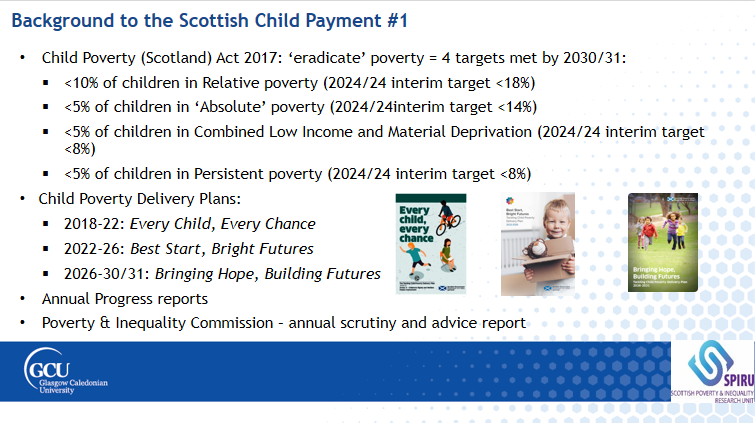
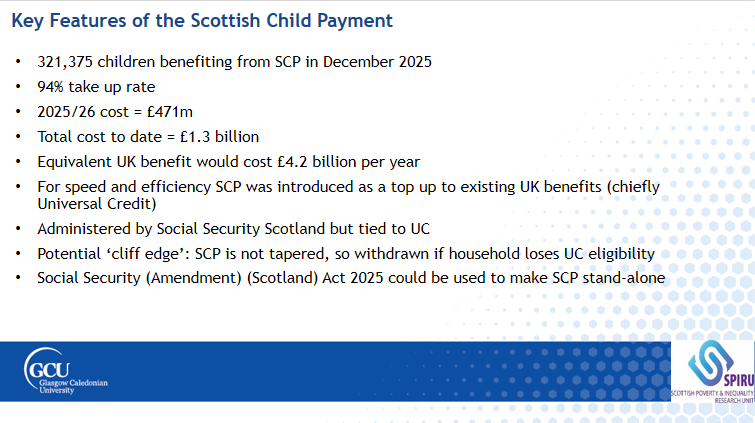
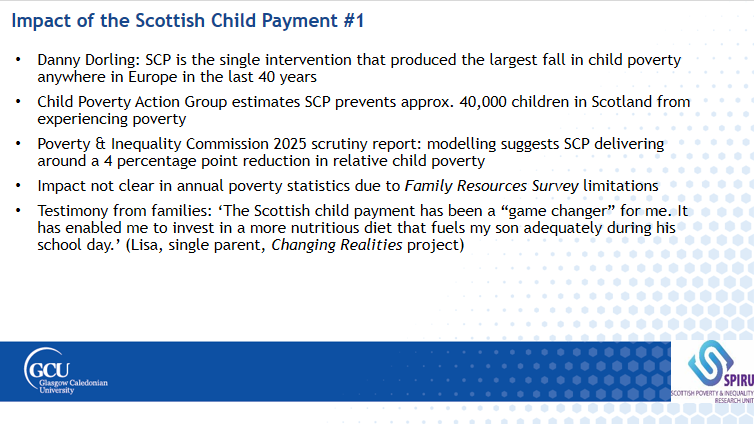
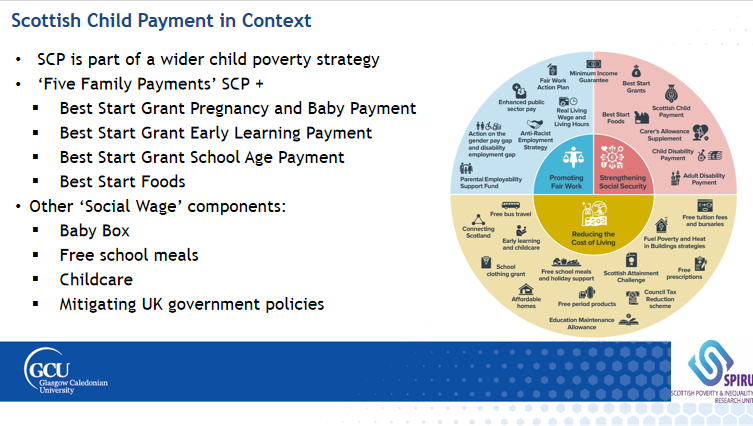
Professor Sinclair’s full presentation can be downloaded below.
Furthermore, at the webinar Professor Sinclair was asked about how to respond to those who look at the overall reduction in child poverty and claim that it cannot be attributed to the Child Payment. As it is an expensive policy initiative, we know that policy makers must be confident in the evidence for its effectiveness.
The Poverty & Inequality Commission Analytical Manager, Keith Dryburgh has provided a short briefing on the evidence on the impact of the Scottish Child Payment, including Scottish Government modelling.
He wrote:
Research on the Scottish Child Payment
The Family Finances Study is a collaborative project with academics and policy partners at the University of Manchester, University of Glasgow, University of York, the London School of Economics, and the Child Poverty Action Group. They are investigating the impact of the Scottish Child Payment on financial and emotional wellbeing and employment using a comparative, mixed-methods approach.
- The Investing in Children: Early findings on the difference the Scottish Child Payment makes to child well-being report, published in December 2025, used a difference-in-difference method, comparing outcomes for Scottish households before and after the SCP to English households.
- The research found that both material deprivation and food insecurity would have been between 8 and 9 percentage points higher in Scotland without the policy, which corresponds to over 70,000 fewer children living in material deprivation and food insecurity as a result of the SCP’s introduction. The qualitative data in the study showed that parents were able to increase spending on items necessary to children’s healthy development such as nutritious food, clothing and utilities.
The Fraser of Allander Institute conducted a preliminary evaluation on the impact of Scottish Child Payment on food bank use. It found Scottish Child Payment had a statistically significant impact on food bank use for some (but not all) household types with children. Specifically, it found decreased food bank usage for single-adult households with children aged 0-4, and households with children aged 5-16 without younger children. Effects were largest in late 2022 and early 2023 after Scottish Child Payment rose to £25 per week.
Furthermore, Keith Dryburgh points out the difficulty in isolating the Child Payment from the rest of the policy initiatives aimed at tackling child poverty. Yet, there has been significant modeling and research on its impact and comparisons across the UK.
Changes to poverty figures in Scotland since SCP was introduced
There is evidence of a reduction in child poverty since the implementation of the Scottish Child Payment. Relative child poverty after housing costs for 2022-25 was estimated to be 21% compared to 25% in 2020-23, a reduction of 40,000 children. In the same period the proportion of children in severe poverty after housing costs reduced from 16% to 13%.
It is difficult to disentangle the impact of the Scottish Child Payment on the reduction in child poverty figures in Scotland, as it is one part of the Child Poverty Strategy and exists in a wider economic context. However, the Scottish Government’s cumulative impact assessments of child poverty strategy policies have found that half of the modelled reduction in child poverty would be from Scottish Child Payments.
Comparisons with UK poverty figures
Scotland’s relative child poverty rate over the period 2022–23 to 2024–25 was 21%, compared with 28% in the UK as a whole and 38% in Greater London. Analysis by the Institute for Fiscal Studies found that this in part reflects lower housing costs, but also that Scotland’s devolved tax and benefit policy has also played an increasingly important role in recent years.
JRF analysis in its 2025 Poverty in the UK publication shows that under central Office of Budget Responsibility (OBR) projections, without any further policy changes, only Scotland out of the UK nations will see child poverty rates fall by 2029. The analysis estimated that the gap between child poverty rates in Scotland compared to England and Wales will have grown, with Scotland moving from being 7ppts to 10ppts below the rest of the UK. Further, it found that almost 1 in 3 children would still be in poverty in England, but in Scotland there would be closer to 1 in 5 children in poverty in large part due to Scotland-specific policies.
The full briefing can be downloaded here.
JRF published their Poverty in Northern Ireland Report 2025, which featured considerable research and modelling on the impact of a child payment here in NI, as well as implementing a Real Living Wage.
They again revised their modelling to take into consideration the impact of the removal of the two-child limit to the child element of Universal Credit. They estimate that a child payment in the North would lift 20,000 children out of poverty and reduce the child poverty rate from 22% to 18% at a cost of £240m. Furthermore, if a child payment was coupled with a baby boost and early year payment, which recognises the importance of investment in families at these stages in life, a further 3,000 children would be lifted out of poverty at a cost of an additional £20mil.
JRF’s updated briefing and modelling is here:
Whilst the Scottish Child Payment cannot be seen as a panacea, the most compelling evidence is the first-hand accounts of how instrumental the child payment has been to families.
I went out and bought her some Clarks trainers because they’re obviously really good trainers. They don’t get scuffed up as quick as what cheaper trainers do. And I went and bought her loads of spare clothes that she could just wear for nursery because obviously, you can imagine their clothes get ruined at nursery. A hat and gloves, a bag, lunchbox, stuff like that. So that really helped out too.
Parent and Carer interview: https://www.gov.scot/publications/evaluation-five-family-payments/pages/4/
This payment has been a life saver, especially since the cost of living crisis. I used to be able to get a decent amount of shopping and essentials every week without worrying too much, but the cost of shopping is unbelievable. Without this payment we would be eating much worse, less fresh and nutritious foods and be relying on cheap frozen food instead.
Survey respondent: https://www.gov.scot/publications/evaluation-five-family-payments/pages/4/
Scottish Child Payment mainly goes toward groceries and keeping our house running. It would be groceries and electricity, would be the main things that that would go on. Every month I rely on it. I’m usually waiting for it to come in. […] I wouldn’t say the payments would always cover my electricity. They’d either cover my groceries and not my electricity, or just my electricity and maybe some of my groceries.
Survey respondent: https://www.gov.scot/publications/evaluation-five-family-payments/pages/4/
The payment has helped immensely it could be rent or food or that’s unexpected new shoes or wow holiday let’s have a treat at the weekend without it we would be in more debt than what we are.
Survey respondent: https://www.gov.scot/publications/evaluation-five-family-payments/pages/4/